
Remembering Professor Michael Sullivan (1916-2013)

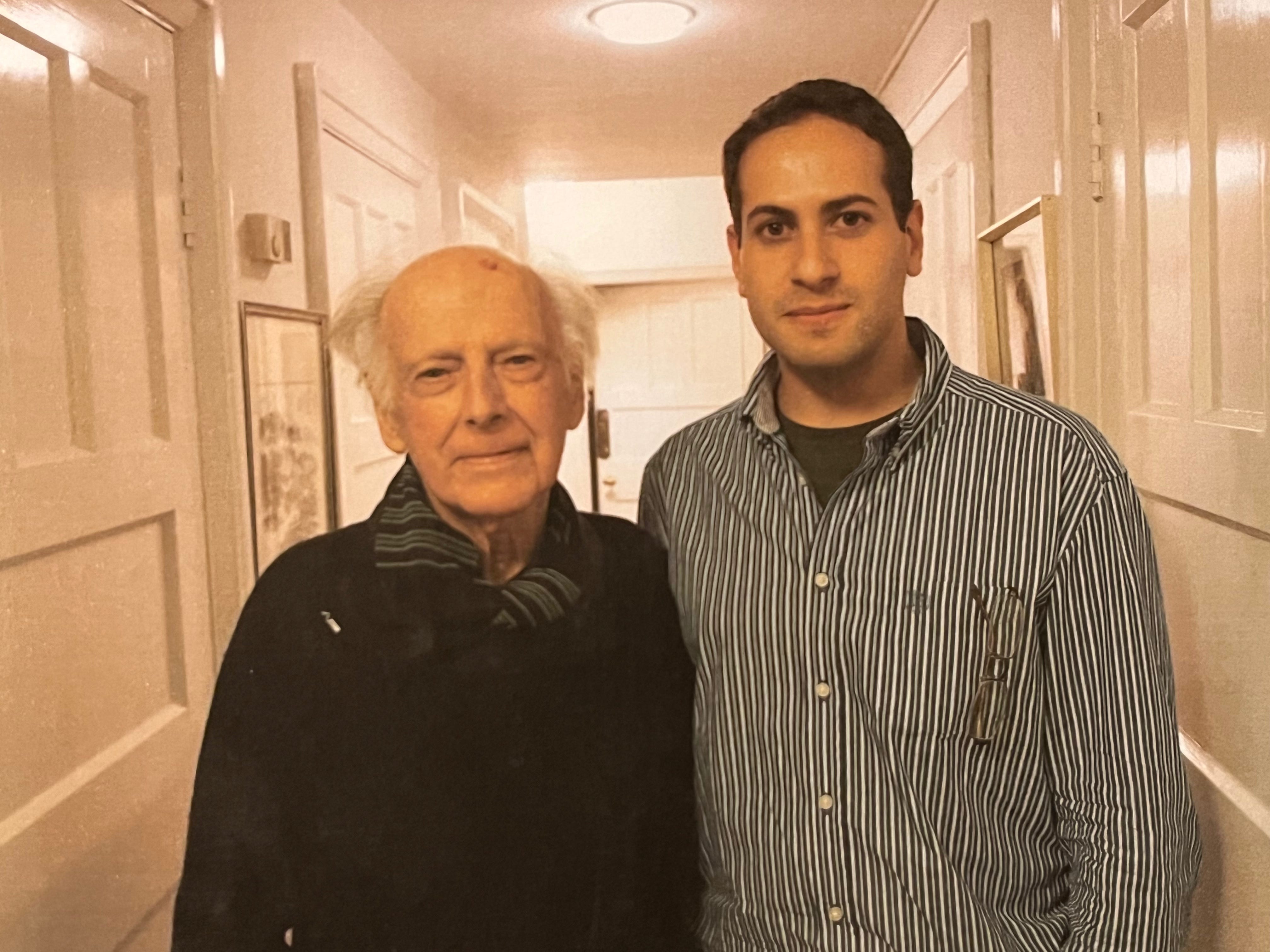
I was sifting through my books the other day when I came across a few volumes by Michael Sullivan, the great scholar of Chinese art. Seeing his name brought me back to my time as a PhD student at Oxford.
I first met Michael at an Ashmolean exhibition opening for Xu Bing. During the drinks reception, Colin Sheaf, then Chairman at Bonhams, where I was interning, introduced us. Michael, impeccably polite, invited me to his house for lunch. The invitation sounded simple enough, though actually getting there was another matter: no address, no time, no clear sense of how one was meant to follow up.
His home gatherings were something of a legend among students of Chinese art. A few of his assistants, bright, young Chinese women who helped him update his book or other projects, would mention them, but always vaguely, almost protectively. It seemed a small, special circle, not something one could enter merely by asking.
One afternoon I saw Michael leaving a seminar and decided to be bold. I asked for his phone number and we arranged a date. I ended up visiting him twice.
The first time, a small group of Chinese art history students were already there. We were all a little in awe. His flat was a living museum: every wall covered with paintings, ceramics, and mementos from a lifetime in art. Despite being in his nineties, Michael was sharp, gracious, and utterly charming. He remembered my name, though I must have been of little consequence. He spoke that old-fashioned English one rarely hears now, elegant yet unforced.
He had a certain charm, especially toward women, though it was always affectionate rather than inappropriate, the gallantry of another age.
The second time, I brought my girlfriend. Michael was instantly more taken with her than with me, giving her a tour of his collection, pointing out favourite pieces and their stories. Many Chinese artists had given him their works; to have a piece in Michael Sullivan’s collection was almost a rite of passage, a mark of having “arrived.”
We sat down to lunch: pizza, to my surprise. I marvelled that a man in his nineties could still enjoy it. Picking up the silverware, I noticed its patina, and Michael smiled: “That was my mother’s wedding present, 1901.” A small detail, but it suddenly connected the present to an impossibly distant past.
Over lunch he told us stories. My favourite was of Zhang Daqian. Michael had worked for the Red Cross in China during the war, despite being a pacifist. He recalled meeting Zhang in Chongqing and being astonished that an artist, usually a penniless profession, had his own rickshaw and coolie. “Zhang was terribly cheeky,” he said, laughing. “He’d wander into museums and declare, ‘I can do better than that,’ or, ‘That one’s by me, it’s a forgery!’”
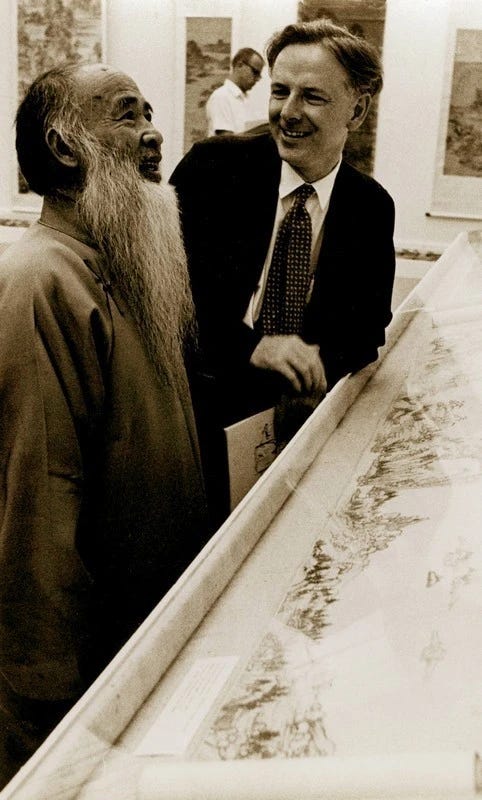
When the afternoon ended, he said goodbye to his “little animals,” as he affectionately called the young Chinese women who worked with him. It was sweet rather than strange, a kind of innocent fondness.
Many people grow more withdrawn with age, but Michael remained youthful in spirit - sociable, curious, alive. Despite his stories of a China that felt as remote as the Qing dynasty, there was never any sense of distance between us. He was sophisticated, witty, and humane, a true gentleman of another age.
I still remember hearing of his death while travelling through Russia. Someone said he had slipped in the bath. It felt like the end of an era.
Meeting him was one of the best experiences of my time at Oxford, and a reminder that art history, at its best, is a conversation between generations, carried by those rare souls who make the past feel vividly present.